
Often in recruitment the target list of the ideal client is not held within the database / CRM / lead gen platform. Often it is held by individual recruiters in their heads, on LinkedIn, a spreadsheet or just in that mythical top drawer.
A key element of an Account-based Marketing (ABM) approach to marketing efforts is building a hit list of these target accounts so that marketing and sales work together to build a list of only viable clients. In addition there is also a list of previous / lapsed clients on the CRM system that could also be valuable, this is also another key strategy within an ABM approach.
Marketing and sales (recruitment) must work together to build out the lists and be in constant communication to make sure that the list remains up to date and relevant for any external marketing activity.
This HIT LIST then becomes the basis for all future marketing activity (B2B).
Key learnings
- What is your total viable market?
- How do you build a hit list?
- How clients types will help you define your list
- What is your total viable market?
Often the marketing efforts of recruitment companies and their marketing teams are based on a broad approach to marketing. Many marketing campaigns are judged on the success of the number of likes, shares, opens, web visits.
Account-based marketing (ABM) is a strategic marketing approach that focuses on targeting high-value accounts or customers instead of mass marketing to this broad audience.
Lead-based marketing and account-based marketing have a fundamental distinction. In the lead-based approach, the marketing team assumes responsibility for crafting content, launching advertisements, and enticing leads to engage with their call-to-action (CTA) choices. Subsequently, marketing plays a supportive role as the sales team takes over and engages with the acquired leads.
Conversely, in account-based marketing strategies, marketing is tasked with ensuring that specific criteria are met by the leads before they are handed over to the sales department. This approach focuses on delivering targeted leads to sales representatives, rather than simply providing a large pool of random leads for qualification.
“Sales teams care about only one thing, and that isn’t your marketing leads.
No, they care about the accounts they need to close this month or quarter.
If you deliver engagement and leads in the accounts they are working on, you will be their hero”
From the book: ABM is B2B, Sangram Vajre and Eric Spett
This is essentially making sure that marketing speak to sales before any activity takes place to define the ideal client profile (ICP) and the total viable marketing (TVM).
In any recruitment company the list of target accounts would be in the 100s not the 1000s. Most recruiters would have their ‘hidden’ list of between 20 and 30 target accounts that they want to work with and open up.
This means that in an average recruitment company of (say) 10 front facing recruiters, that you would have between 200 and 300 target clients. Maybe one or two actual people in those businesses, so 500 or so target clients.
Then each recruiter will have their top 5 target accounts so top level 100 clients.
Seth Godin calls this the Micro Tribe. The smallest market to survive on.
Or Kevin Kelly’s 1,000 True Fans.
In marketing, this is all about segmentation. Once marketing and recruitment have worked out together that they actually have a small number of defined accounts, marketing becomes easier and can become laser focussed – client-side, anyway.
2. How do you build a hit list?
It is necessary that sales and marketing work together from the beginning. If this pair of natural forces learn how to share and combine their respective insights, they should be able to craft a practical, accurate, and trustworthy ideal customer profile (ICP) for every desired account, which also translates into the foundation for ABM success.
Marketing must take the lead in bringing the list together, as it then must form the foundation of all marketing activity moving forward.
Stage 1 is a conversation with each and every recruiter.
- Who are your target clients?
- What work do we do with them now?
- Are they historic / lapsed clients?
- Is it a land and expand opportunity?
- How would you rate our relationship with them?
- What is your commercial objective with them?
- Who are the key decision makers? – Names and job titles.
- Who else do we need to know?
- Do they sit on any other recruiter’s list?
This list will then need collating. It might need cleansing and adding to, dependent on the type of relationships and accounts. This can be done through external sources (list builders) or through a third party lead checker.
Once this list is developed a good idea is to add it into your system – whichever one you are using and also print it all out, make it visible across the office and the business. This is the LIST, the HIT LIST.
The is a list of PEOPLE not PERSONAS. This list is now the basis of ALL marketing activity. Marketing celebration is a celebration of interactions within this list, not any vanity metrics.
3. How clients types will help you define your list
There are three types of clients in a recruitment company.
And there are multiple types below this top level and also different types of clients in there (HR, hiring mangers, FDs, CEOs, MDs).
The model also represents the volume of clients in each segment, as you move up the Key Account Management scale.
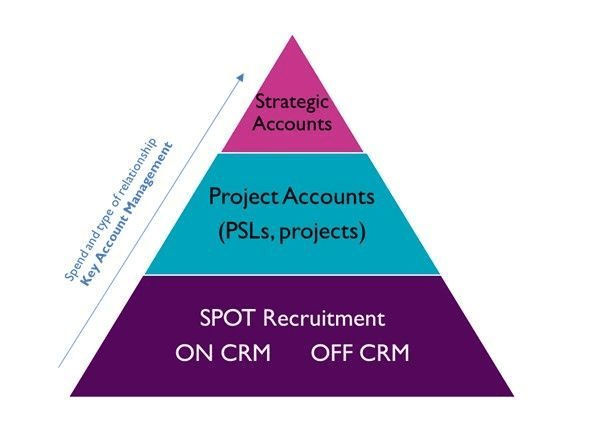
Spot business. Or candidate led.
A key ABM approach would be content based on the benefits of a partner approach to recruitment, how working together can be beneficial for both parties. Often these type of clients are hidden deep in the CRM system.
Project Accounts. More jobs, a better relationship.
Here is about being a partner. Marketing can help here with content on EVP, with lead gen on benefits and the success of the projects (NPS, time to hire, cost, data).
This type of client would make up the majority of the target accounts from most good recruiters.
Strategic Accounts. Client led.
Treat the client like gold dust. Marketing here is about experience, about knowledge and working together. Case studies and client led content on projects work well here.
For each different type of client / their segment marketing must develop different types of content.
And this content must be built on Not personas, but people: customers with names, job titles and problems you can help solve, based on your current relationship and your desired relationship.
In conclusion
Marketing and sales must collaborate to develop a visible target client list for effective marketing activities.
Creating a hit list of client accounts, marketing becomes more focused, leading to better lead conversions. It is essential for marketing professionals in recruitment companies to know their top clients and prospects, as this knowledge is fundamental to their role.
Controlling the hit list facilitates improved marketing results, increased awareness, and demand generation.
Starting the ABM journey is as simple as initiating conversations and building relationships with the target clients, but the conversation must start internally, between sales and marketing.
 ABM IN RECRUITMENT
Leave a comment